
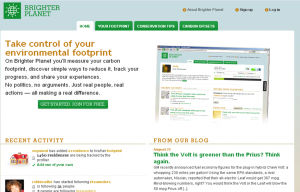
, the clean-energy start-up that began with a carbon offset credit card and promises to make environmentalism accessible to everyone and fun to share, recently re-launched their site. The site is now supposed to help consumers take charge of their carbon footprint and save money. We caught up with the CEO Patti Prairie to find out more about this exciting new resource.
Read the press release here
Watch Big Feet, Little Planet and Shrink & Save videos here
COD: Congratulations on the re-launch of your site. Can you introduce us to what’s new and how a consumer will use the web utility of to minimize their carbon footprint?
Patti: Thanks — it’s been a long haul. We put more than a year into planning and building our new site, partnering along the way with some of the most sought-after strategists and designers in the web industry.
The new is like a personal trainer, or Weight Watchers, or a personal-finance tool like ; it helps you discover how to get started and keep making changes, provides feedback on your performance, and helps people connect with a supportive community that shares the same goal. No one is currently providing the kind of help most of us need to live more carbon-free.
from on .
COD: Carbon is found in anything and everything. How does your carbon calculator assess the carbon impact of the users, especially the busy people with active lives and full schedules?
Patti: Our goal is to help people — especially those with busy, active lives — get a complete picture of their carbon footprint without being overwhelmed. Visitors to Brighterplanet.com answer questions powered by a sophisticated emissions model and watch their carbon footprint — as individual as a fingerprint — emerge. Each footprint, unlike a fingerprint, changes over time as lifestyle choices change.
Our carbon calculator is unique for three reasons.
First, it starts by assuming an ‘average’ American — that is, someone who has 1.1 homes, drives 0.76 cars, flies 2.6 times each year, and so on.
Second, visitors answer as many or as few of a broad range of questions at their own pace. For example, you can say you drive a midsize SUV or enter your car’s exact make, model, and annual mileage. The more you answer, the more precise your footprint estimate and more tailored your conservation recommendations can be. We store your information in your personal profile, so as you begin to make real headway, you can return to the calculator, add more information about behavior and choices, and reflect accomplishments.
Third, we go the extra mile to research and report on emissions from things like food, clothing, trash, and government services. As you point out, carbon is in anything and everything. We don’t leave anything out.
We’re applying on a personal scale the same quantitative mindset that powers Google medical research, and other data-intensive breakthroughs. Wired’s recent articles chronicled a data-driven revolution of personal metrics, one that helps hone your health, nutrition, and exercise. We’ve set out to do that for the environment.
COD: Given the fact that Americans in the National Geographic’s recent Greendex survey on consumer progress toward environmentally sustainable consumption and citizen behavior, what is the level of participation you expect from the people?
Patti: Well, a second finding of that survey is that Americans also exhibited a stronger-than-average belief that their personal actions can make a difference. The gap between those findings is exactly where we see an underserved need.
It’s a very daunting task for someone to sort out the environmental wheat from the chaff and to figure out what they can really do to become CO2 fighters. Plenty of books and websites present tips to live a greener lifestyle. And there are many web-based carbon calculators out there. But where to begin? What should your overall goal be, and what should you single out as early objectives? How do you keep track of your progress?
We make it easier for people to progress toward a more sustainable lifestyle by providing tools for them to learn and engage. Taming one’s carbon footprint is a lot like learning to manage and budget your money, adopt an exercise program, or plan and make healthier meals for your family — all these are about setting goals, learning new habits, making informed personal choices, and taking first one step and then another to make a difference.
COD: Brighter Planet.com seems to lay its focus on users of online social networks. Can you explain the rationale behind this focus area?
Patti: We believe that it takes a movement to fight climate change. A grass roots movement. And what better way to help grow a grass roots movement than with a social web application?
Our best shot at building a strong, active core community lies in engaging people who (a) really want to help solve global warming, and (b) are leading fast-paced, demanding lives. Young urban professionals, parents with young children, small business owners — these are the sort of folks who’re truly experiencing the problem Brighterplanet.com will now help them solve.
And these people tend to have discovered that the “social web” in general — the mix of big networks like Twitter and Facebook, media-sharing services like Flickr and YouTube, and niche communities like BlogHer, Etsy and even Amazon — can really help them get things done, can empower them. Small-business owners discover that they can use Twitter, Facebook, and blogging to elevate their promotional reach and develop valuable relationships. Mothers with young children learn that they can avoid isolation and feel powerfully connected to others by becoming “mommy bloggers.” And tech-savvy urban professionals stay constantly connected to friends, jobs, and trends through their iPhones and Blackberries.
In other words, these are people who’ve come to expect that they’ll find answers to just about any dilemma on the web. That recent iPhone commercial sums up this expectation: “There’s an app for that.” We’re confident that Brighterplanet.com is the kind of simple, and social, web solution these people want. We also hope anyone who wants to save energy, save money, and do something about climate change will find our new site useful.
from on .
COD: Brighter Planet guides people on emissions, conservation and offsetting the rest. Who benefits from these carbon offsets?
Patti: Everyone. The person or business that buys the offsets reduces their impact on the climate. Schools, farms, and communities across the country benefit from the economic and educational opportunities our offset projects create. The US economy benefits from the investment in green jobs and clean domestic energy. And ultimately, of course, our children and grandchildren will benefit from inheriting a planet less devastated by a climate gone haywire.
COD: Carbon offsets continue to receive a good deal of criticism. What’s the bottom line, are carbon offsets a useful tool or not?
Patti: Carbon offsets are not just useful, they’re critical. You can cut your footprint in half with painstaking conservation, but you still need to feed your family, heat your home, go to work, get your kids to school and to after-school events, and all kinds of other emissions-creating activities that are part of your everyday life.
The fact of the matter is that once you’ve taken those steps to conserve, tweak or thoroughly revamp your lifestyle, you still contribute to greenhouse gas emissions. Further reductions may not be possible or may be so costly as to do less for the planet than investing in reducing emissions through carbon offsets.
Offsets by Brighter Planet can be another arrow in your sustainability quiver. We invest in only the most reputable American renewable energy projects – ones that are real, additional, transparent, and provide community and social value. Whether you reduce your own emissions by a ton or you support an offset project that reduces emissions by a ton, the net result is the same: a material reduction in greenhouse gases being pumped into the atmosphere.
Most of the criticism leveled against offsets is only valid for a small minority of the market. Rather than sell themselves short by categorically dismissing carbon offsets, potential buyers should do the research to find an offset provider committed to transparency and quality. It’s becoming increasingly easy as standards evolve, the market matures, and carbon offsets prove they have a solid track record of achieving real reductions in greenhouse gas emissions.
Visit

{ 2 trackbacks }
{ 5 comments… read them below or add one }
CarbonOffsetsDaily.com: INTERVIEW: Patti Prairie, CEO of BrighterPlanet.org on how social: Full
This comment was originally posted on
INTERVIEW: Patti Prairie, CEO of BrighterPlanet.org on how social networks and their new site help fight climate..
This comment was originally posted on
INTERVIEW: Patti Prairie, CEO of BrighterPlanet.com on how social …: Wired’s recent Living by Numbers arti..
This comment was originally posted on
INTERVIEW: Patti Prairie, CEO of BrighterPlanet.com on how social …
This comment was originally posted on
Feeling good about our CEO’s interview in Carbon Offsets Daily. You go, Patti…
This comment was originally posted on