United Parcel Service (UPS), one of the leading shippers in the United States, became the first small package carrier to offer customers the chance to buy carbon offsets to neutralize the greenhouse gas emissions generated by the transport of their packages. We asked our
- Author: admin
- Published: Oct 13th, 2009
- Category: Interviews
- Comments: 3
Interview: Scott Wicker, VP Sustainability, UPS on UPSs Per-Package Carbon Offsets Service
- Author: admin
- Published: Oct 2nd, 2009
- Category: Interviews
- Comments: None
Interview: Lew Middleton, Communications Manager of Duke Energy-Indiana, on bringing carbon offsets to Hoosiers
Duke Energy
- Author: admin
- Published: Aug 25th, 2009
- Category: Interviews
- Comments: 2
INTERVIEW: Patti Prairie, CEO of BrighterPlanet.com on how social networks and their new site help fight climate change

, the clean-energy start-up that began with a carbon offset credit card and promises to make environmentalism accessible to everyone and fun to share, recently re-launched their site. The site is now supposed to help consumers take charge of their carbon footprint and save money. We caught up with the CEO Patti Prairie to find out more about this exciting new resource.
Read the press release here
Watch Big Feet, Little Planet and Shrink & Save videos
- Author: admin
- Published: Aug 10th, 2009
- Category: Interviews
- Comments: None
Interview: Yobie Benjamin on TrueCarbon.org
is a start-up operating in stealth mode. We were fortunate to meet Yobie Benjamin, a Principal at TrueCarbon.org, to get a sneak peak behind the curtain.
COD: Before we talk about TrueCarbon.org it would be valuable to get a sense of your background. You were the founder of GoodStorm.com, a company that created e-commerce tools that enable socially responsible organizations to open online stores and generate income from merchandise sales. You’re a board member on a couple other social and environmental related organizations. What’s driving you?
- Author: admin
- Published: Aug 7th, 2009
- Category: Interviews
- Comments: None
Interview: CEO and Founder Robert Fell of Pricelock on CarbonLock
, based in Redwood City, California, combines technology and commodities expertise to offer businesses price predictability to increasingly volatile fuel prices. The company also offers CarbonLock, a unique, patented “green fleet” program that allows fleets and businesses to efficiently acquire certified carbon offsets and become carbon neutral. We caught up with CEO and Founder Robert Fell to learn just how CarbonLock works.
Checkout the
- Author: admin
- Published: Jul 27th, 2009
- Category: Interviews
- Comments: None
Interview: Neal Dikeman Co-founder of Carbonflow on web technology’s role in addressing climate change.

Carbonflow, a venture dedicated to bringing automation and transparency to the carbon market, is a web-based software technology that works to drastically lower the cost and time it takes to create a carbon credit. We took some time to connect with Neal Dikeman, Co-founder and Chairman of the Board of Carbonflow, to learn a bit more about this revolutionary product.
COD: How does Carbonflow help developers of GHG reduction projects?
- Author: admin
- Published: Jun 16th, 2009
- Category: Interviews
- Comments: None
Interview: method co-founder and chief greenskeeper on Planet Metrics Rapid Carbon Modeling

- Author: admin
- Published: Jun 16th, 2009
- Category: Interviews
- Comments: 2
Interview: CEO of Planet Metrics on unveiling of new Rapid Carbon Modeling technology
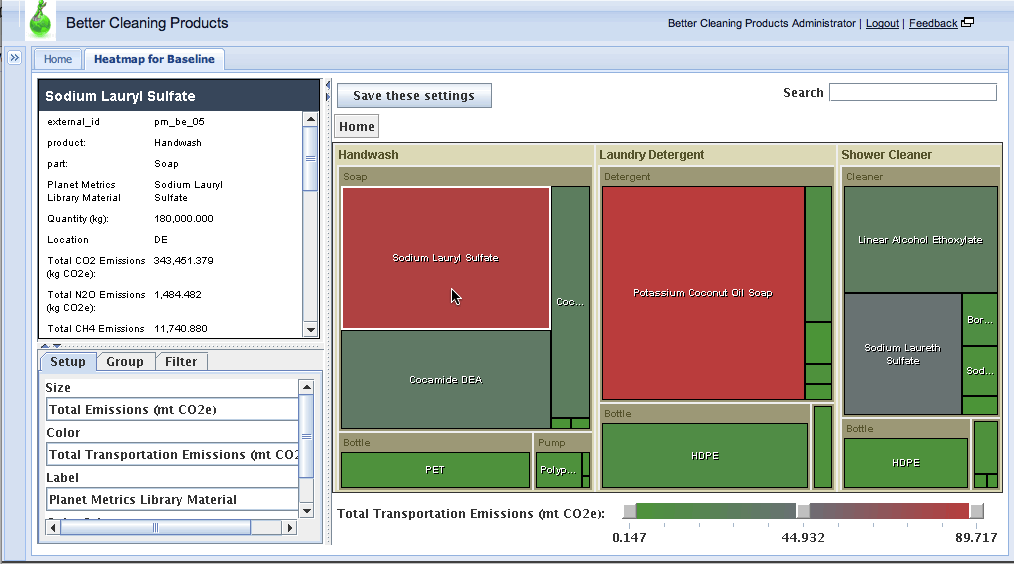
(Heatmap screen of new RCM software)
new Rapid Carbon Modeling (RCM) technology SaaS Solution sounds like a valuable resource for a wide spectrum of companies and industries. We took some time to connect with Andy Leventhal, founder and CEO of Planet Metrics, to learn a bit more about this exciting news.
COD: seems like it is being introduced to the market at a perfect time. Can you give us an idea of who you expect to use this tool and what the value proposition is for your customers?
- Author: admin
- Published: Nov 24th, 2008
- Category: Interviews
- Comments: 2
Interview: Justin Brown, CEO of FGX, on cutting shipping emissions by 30%
Q. Hi Justin, and welcome to Carbon Offsets Daily. The recent news about cutting emissions by 30% is significant for business decision makers who are exploring ways to address their carbon footprints. Can you explain how you do it?
A. Well, we have been able to achieve this benchmark by reorganizing the common business model used in the shipping industry. Big shipping companies use a model known as
- Author: admin
- Published: Sep 11th, 2008
- Category: Interviews
- Comments: None
Interview: Paul Smith of GreenSmith Consulting
Q. Hello Paul and welcome to Carbon Offsets Daily. Lets first talk briefly about your business . What type of projects do you take and how do you help businesses go green?

Thanks Affan. Im a bit of a green business Swiss army knife, offering a range of services, from social media marketing campaigns to creating a sustainability plan for inside/outside the company. Currently Ive been doing a lot of social media marketing campaigns, with companies like , , and .
Q. How can sustainability consultants, offset providers and others offering green business solutions use the internet to promote their business?
Thats a big question, whose answer depends a lot on the type of company and who their target market is. I can help discern which.
For many, however, a common denominator is blogs and social media tools such as Twitter. They are free or very inexpensive means to get out the word about what you do, quickly, and ongoing. Being able to connect with, learn from, inform and be inspired by your customers goes a very long way towards building a strong foundation and solid sales for a business. For instance, I recently wrote an article about Berkeley, California based that got more than 150 people visiting their site directly from the article. That type of awareness of the exact effectiveness of marketing is powerful.
Another tool I recently saw is . Its a simple, intuitive way for your customers to let you know what theyd like to see offered, and for you to let them know if its already in progress. People suggest ideas, see if theyve already been submitted, and then have 8 total votes for whatever among the ideas interests them.
Q. In this regard, what would be the best choice for someone with a limited budget and time?
Hire me! But seriously, using tools such as Uservoice, the amazingly powerful , blogging, and social media news sites like , , and , if leveraged correctly, can produce great results. I will gladly consult with people to both do it for them and show them how to do it themselves. Its not merely a matter of put content out there and hope for the best. But it also doesnt have to be hard, either.
Q. For a business that wants to cut its footprint, what are the pros and (possible) cons of hiring sustainability consultants?
Lets start with the cons. There are an increasing number of people calling themselves sustainability consultants. You should make sure their background and training is sufficient to have the knowledge youll want to know and the support you want for your business. At the same time, sustainability focused business as a broader trend is comparatively new, so be sure not to have standards beyond what any one person or company could have.
Using myself as an example, I am the product of one of the original sustainability focused MBA programs, , based in San Francisco. It gave both a broad, in depth knowledge of sustainable business, and at the same time, a solid grounding in how business has and is currently being done. In this way, I am able to act as a bridge between the two
- Author: admin
- Published: Sep 2nd, 2008
- Category: Interviews
- Comments: None
INTERVIEW: ClimateCHECK on the Future of Carbon Credits
The following interview is based on a story that we recently ran about JPMorgan
- Author: admin
- Published: Aug 22nd, 2008
- Category: Interviews
- Comments: None
INTERVIEW: GreenLife on the Future of Carbon Credits
The following interview is based on a story that we recently ran about JPMorgan “Cooking up Carbon Credits” (that you can view here: JPMorgan Chase Subsidizes Stoves in Africa to Earn Carbon Credits).

The recent news about JPMorgan “Cooking up Carbon Credits” underscores the booming carbon market. It seems the carbon market is only going to get bigger. What do you think will happen as more capital gets into this market?
Climate change is an enormous problem, and will thus require enormous resources to solve. It is not going to be solved by NGOs and people making donations alone. It requires these kinds of large-scale investments. My hope is that the capital flowing into carbon credits will spur investments in a wide variety of climate efforts: new technologies, acceleration in the growth in renewables, innovative strategies, etc. We are already seeing an increasing level of sophistication as more businesses and financial institutions get involved. Before long, carbon markets should function much more like mature existing commodity markets. What I am hoping we see more of, too, is billions in venture capital helping to finance projects at very early stages.
JPMorgan earns carbon credits by subsidizing stoves in Africa. These carbon credits are then sold to companies at a price that is reportedly higher than the retail value of the stove. Do you think such initiatives should be predominantly revenue driven?
I believe that money will flow to where profits can be made. If JP Morgan makes a lot of money on this project then hopefully millions or billions of other dollars will start flowing into more projects. Thats good.
Do you think government intervention to subsidize carbon credits/cap credit prices will encourage more companies/individuals to offset their emissions?
I do not think government should subsidize carbon credits or cap prices directly, although I do believe government can help to spur technologies and practices through effectively targeted tax policies (including elimination of counterproductive tax breaks). In fact, I believe that emission allowances should be auctioned and not given away (which is essentially a government subsidy). Voluntary carbon credits are pretty inexpensive now. Im not sure government intervention to reduce prices will have much effect on the number of individuals or companies that choose to offset.
Steve Offutt
Business Development Director
- Author: admin
- Published: Aug 13th, 2008
- Category: Interviews
- Comments: None
INTERVIEW: Kevin Smith of PLATFORM – Unraveling the Carbon Web
Fossil fuels are the primary cause of climate change, which threatens catastrophic damages including massive sea-level rise, rising incidences of flood, drought and other extreme events, major water and food supply reductions, and the spread of disease.

PLATFORMs focus is to reduce the environmental and social impacts of oil and to support the transition to a more sustainable energy economy. We recently posted on a new report, Cashing in on Coal, that Unraveling the Carbon Web released and caught up with Kevin Smith of to learn more.
What does Cashing in on Coal highlight?
The report highlights the role that private finance plays in pushing Read the rest of this entry »
- Author: admin
- Published: Aug 5th, 2008
- Category: Interviews
- Comments: 1
INTERVIEW: Carbon Retirement – Co-Founder Dan Lewer
We recently caught up with Dan Lewer, the Co-Founder of the recently launched Carbon Retirement.
So what is your company all about?
Carbon Retirement was founded in 2008 by me and two colleagues. We wanted to offer a service focused on emission reductions. While we could see that there have been lots of interesting innovations in the voluntary market, we felt that it’s often difficult to evaluate the environmental benefits of offsetting projects. Retirement of allowances from EU Emission Trading Scheme – which is what we do – is a process that delivers unambiguous reductions in carbon emissions and we wanted to give everyone the opportunity to do it. We started taking orders in July this year.
How is Carbon Retirement different to other types of offsetting?
Existing types of offsetting work by investing in projects in the developing world that reduce emissions or absorb greenhouse gas from the atmosphere. Typical projects include tree planting and building renewable energy generators. Carbon Retirement is a fundamentally different approach – it works by buying heavy industry’s rights to release carbon dioxide.
What is the EU Emission Trading Scheme?
It’s a system that European governments use to support their commitments to reduce greenhouse gas emissions. It limits carbon dioxide emissions from a range of industries, including power generation, offshore extraction, cement production, iron and steel, paper and pulp and chemical processing. The EU Emission Trading Scheme is the world’s largest cap-and-trade scheme. In a cap-and-trade scheme, an authority allocates a fixed number of pollution permits to the participants. Each permit is a right to release pollution (in the EU Trading Scheme, each is the right to release one tonne of CO2). Permits can be traded between the participants. This creates a market in permits and a market price.
How is the price calculated?
One of our key principles is to be transparent about where our customers’ money goes. The price we charge is based on the market price of EUAs. For customers using our website, we add an admin fee of 10% (which pays the company’s overheads) and a ‘spread fee’ of 5%. The spread fee covers the risk of the price moving upward between the order being made and Carbon Retirement purchasing EUAs. If the price goes down, we reserve the surplus for retirement of further EUAs. This breakdown is published on our website. For organisations that are thinking about retiring more than a couple of tonnes, the price would work differently.
Why does the price of EUAs change?
Fundamentally, the market price of EUAs is determined by the perceived cost of complying with the reduction required by the EU Trading Scheme. During trading, the market participants’ views of the cost of achieving the reduction can change, which is why the EUA price changes. Energy markets are important drivers. When demand for energy is high, demand for EUAs to cover the generation rises too. Burning coal produces particularly large quantities of greenhouse gases, so the price of EUAs is sensitive to demand for coal.
Where do you buy EUAs from?
From an exchange, a market broker or a regulated participant in the market. EUAs are freely tradable between market participants, so the source of an EUA does not affect the environmental benefits of retiring it.
Project-based offsets often have social benefits. Are there any social benefits to taking EUAs out of circulation?
We don’t think we’re fence-sitting here by saying sort of. We facilitate emission reductions in Europe, and we’re dealing with major energy-intensive industries, so there’s less opportunity for helping out communities at the same time.
The social benefits of offsetting projects can be hard to measure and we need to remember that our aim here is to reduce emissions. Globally, emission reduction and mitigation of climate change will have plenty of social benefits. We’re focused on making sure the emission reductions happen.
How does your calculator work?
Our website gives individuals the option of calculating the emissions associated with flights, driving or other activities, and then retiring a corresponding number of allowances.
Once data has been entered into the calculator, we multiply it by emissions factors. For example, if you input that you have driven a certain number of miles in a large petrol car, we multiply that distance by a factor showing the greenhouse gases released for each mile.
The factors and methodology behind the calculator follow the UK government’s guidelines for calculating a carbon footprint.
Where can I go to find out more about climate change and the EU Emission Trading Scheme?
For the trading scheme, I’d recommend the European Commission’s website. There’s also a straightforward overview on ‘s site. There is a wealth of information about climate change out there. The BBC’s website is a pretty good place to start.
- Author: admin
- Published: Jul 30th, 2008
- Category: Interviews
- Comments: 3
Interview: Everything’s Dynamic on the Soundness of Carbon Offsets to Combat Global Warming
Carbon Offsets Daily: Do you think companies should use carbon offsets to mitigate their global warming emissions?
I don’t see anything wrong with a company purchasing carbon offsets in an attempt to mitigate their carbon emissions, but I don’t think that it’s a panacea to climate change situation. If purchasing carbon offsets (and advertising that fact) can increase a given company’s profits, then it should definitely do so. However, I think a more effective way to deal with a company’s carbon emissions is by reducing energy consumption and making its operations more efficient. Finally, I think the best way to mitigate global warming is not through the transfer of carbon credits in a cap-and-trade scheme, but rather by instituting a tax on sources of carbon emissions (such as coal, natural gas, petroleum products, etc.) so that non-carbon-emitting energy sources (such as wind, solar, nuclear, geothermal, etc.) become more cost-competitive.
Christopher Monnier
- Author: admin
- Published: Jul 28th, 2008
- Category: Interviews
- Comments: 1
Interview: Carolyn Elefant on the Soundness of Carbon Offsets to Combat Global Warming
Carbon Offsets Daily: Do you think companies should use carbon offsets to mitigate their global warming emissions?
Carolyn Elefant: Companies should first focus on alternative measures to reduce global warming emissions. For example, many companies use offsets to counterbalance the impact of air travel, though in many cases, they could replace the travel with phone communications or webinars. Similarly, for utilities, direct purchases of renewable power will reduce global emissions far more effectively than offsets. To the extent that offsets help fund or subsidize renewable energy, I believe that they are a valuable tool in combating climate change. However, offsets should not be regarded as a free pass for companies to maintain the status quo vis-a-vis their current practices.
These views are my personal views and do not represent an official position of OREC.
Carolyn Elefant, Law Office of Carolyn Elefant and Ocean Renewable Energy Coalition
- Author: admin
- Published: Jul 25th, 2008
- Category: Interviews
- Comments: None
Interview: AskPablo on the Soundness of Carbon Offsets to Combat Global Warming
Carbon Offsets Daily: Do you think companies should use carbon offsets to mitigate their global warming emissions?
I think that verified, high-quality carbon offset credits are an excellent market mechanism for achieving emissions reductions. Of course the use of offset credits should come after all feasible energy efficiency improvements are made and all renewable energy alternatives are explored. Even then the use of offset credits should continue to be only part of a company’s efforts to reduce their emissions. In order to create meaningful reductions in emissions a carbon credit needs to meet regulatory and financial additionality, be quantified using a rigorously validated, and ISO 14064-2 compliant, methodology that requires relevance, completeness, consistency, transparency, accuracy, and conservativeness, as well as being third-party verified to the ISO 14064-3 standard.
- Author: admin
- Published: Jul 23rd, 2008
- Category: Interviews
- Comments: None
Interview: AboutMyPlanet on the Soundness of Carbon Offsets to Combat Global Warming
Carbon Offsets Daily: Do you think companies should use carbon offsets to mitigate their global warming emissions?
Companies should do whatever is possible to help the environment. Carbon offsets is certainly one way to do so, however it seems like an easy way for a company to say they’re environmental friendly. There should be much more emphasis on companies going green by changing the way they do business, investing in alternative energy generation where ever possible. This will promote the use of alternative energy and bring costs down for anyone who is interested in moving in that direction.
Bart Dabek
Founder
- Author: admin
- Published: Jul 20th, 2008
- Category: Interviews
- Comments: None
Interview: Maria Energia on the Soundness of Carbon Offsets to Combat Global Warming
Carbon Offsets Daily: Do you think companies should use carbon offsets to mitigate their global warming emissions?
Companies should use carbon offsets as a last resort to offset their global warming emissions. First and foremost, they should invest in energy efficiency and renewable energy. Then, when they have maximized those technologies, they may use carbon offsets from a legitimate company with certified carbon offsets. I am skeptical of many companies that seem to buy offsets as a "quick fix" to their emissions…a more meaningful, sustaining impact should be made first with efficiency and renewables.
Maria Surma Manka
Blogger
- Author: admin
- Published: Jul 9th, 2008
- Category: Interviews
- Comments: None
Interview: SustainableWebsites on the Soundness of Carbon Offsets to Combat Global Warming
Carbon Offsets Daily: Do you think companies should use carbon offsets to mitigate their global warming emissions?
Yes. The old saying in carpentry is "measure twice, cut once"
and I think it applies to offsets too. First, take a baseline
measurement of your existing carbon dioxide footprint, and begin
offsetting as soon as you can. Then, determine areas where you can cut
down on the the actual CO2 produced, so that you can purchase less
offsets. The act of purchasing carbon offsets is only the first step
towards true sustainability, but it is a very important one because
without measurement you don’t know where to start. So, if you can
"measure and cut" and then continuously improve, your company will be
truly living up to its potential in terms of helping the impact of its
activities on global warming. A complete sustainability strategy
should also measure and then reduce waste and water usage as well as
energy, and include social and labor considerations.
Ivan Storck
President, SustainableWebsites.com
- Author: admin
- Published: Jul 5th, 2008
- Category: Interviews
- Comments: None
Interview: Sustainable Travel International on the Voluntary Carbon Market
Carbon Offsets Daily: When do you think the domestic voluntary carbon market will become a
compliance market and how will that change affect the environment?
: The question may be if instead of when, as I think the voluntary market will continue to flourish and evolve in various forms along with the compliance market, at least for a while. What well see is a convergence of standards and or more regulation on the voluntary side. However, we have enough leaders now who realize that policy, and therefore the compliance market, may not be able to move quickly enough to deal the scale of the issue at hand. In addition there will be plenty of entities that will fall outside the compliance market who will still participate (including individuals). One affect we may see, however, is how credits from projects
that meet overlapping standards that move to the compliance market may increase price and decrease volume on the voluntary market. What will be interesting is the ability of both markets to react to these shifts, particularly as compliance comes into play most likely in the next U.S. administration.
Peter D. Krahenbuhl
Vice President, Co-founder
Sustainable Travel International
Leave the World a Better Place
- Author: admin
- Published: Jun 28th, 2008
- Category: Interviews
- Comments: None
Interview: Carbonfund.org on How to Choose a Carbon Offset Partner
Carbon Offsets Daily: How should a company choose a carbon offset partner?
Companies should choose an offset partner that aligns with
their strategic goals. Ive found that their goals are often twofold. The
first goal is credibility: companies want to address their responsibility for
climate change by offsetting their carbon footprint, not by tossing their money
away. The second goal is to get the message out about their environmental
leadership, which helps them distinguish themselves from their competitors and
craft a compelling story about their business.
Carbonfund.orgs business programs focus on addressing those
needs. Theres no way to get credibility without supporting real projects that
are third-party verified to high-quality certification standardswhich all Carbonfund.orgs
projects are. We explain the sometimes confusing certification and
verification process so partners can judge for themselves. Sometimes partners
visit the projects with us to see the results of their donations firsthand, and
weve put footage from visits to a number of our projects up on our Our nonprofit status also boosts our credibility: were
mission-driven, which means were out to solve climate change, not profit from
it.
We have several ways to help companies get the message out
about their environmental leadership. Our CarbonFree Partnerships Program
offers press releases and tips on speaking with the media, and our blog and
newsletter spread the word. Its in our best interest to help our partners get
their message out because that in turn spurs other companies to take action on
climate change. Its a beautiful cycle which we hope will ultimately result in
transformation of the entire economy toward a clean energy future.
William Bert
Communications Specialist
- Author: admin
- Published: Jun 25th, 2008
- Category: Interviews
- Comments: None
Interview: ClearSky Climate Solutions on the Voluntary Carbon Market
Carbon Offsets Daily: When do you think the domestic voluntary carbon market will become a
compliance market and how will that change affect the environment?
: We at ClearSky Climate
Solutions are of the opinion that the US will support both voluntary and regulatory
markets simultaneously for some time to come.
While there are very
encouraging signs that both of the presumptive presidential candidates have
expressed support for a compliance market for Greenhouse Gases, it is clear
that any significant legislation will have challenges clearing the Senate as it
is currently composed. That said, current regional, state and city initiatives in
conjunction with better climate change education and outreach have combined to
generate enough public awareness that climate change legislation is
consistently presented and will eventually pass. Even if a voluntary
market were quickly created in the US, it is almost certain not to capture vast
sections of the greater economy. A cap-and-trade system will most likely
not apply to individual consumers, small businesses or businesses that generate
indirect emissions. That leaves the voluntary market a sizeable population.
If the voluntary market is
going to continue to expand it needs to become a market where buyers have
confidence that the credits they purchase are indeed what they claim to
be. We believe that the proliferation of certification standards for the voluntary
market, while a bit unwieldy at the moment, is a positive step. With a
little more maturity, the voluntary market will converge upon a couple of certification
standards and the products brought to market will become more
standardized. It is of vital importance to retain consumer confidence, with
well-developed standards, transparency and an open governance processes. The
potential for the voluntary market is larger than the regulatory market, but
the relative price volatility may limit initial investments. That said,
if the voluntary and/or regulatory markets are going to help the environment as
we believe is possible, there is a rapid need for significant expansion.
Currently, the sum of all greenhouse gas markets is not enough to stabilize
atmospheric chemistry.
While, businesses and individuals are interested in continuing to support
carbon credit projects that offer additional environmental and social benefits it
is vitally important to catalyze a process to change lifestyles. To
promote activities that reduce our carbon emissions and encourage us to consume
less. Whether this is done through economic incentives such as carbon
taxes, or stimulated through educational campaigns or pop culture, these should
be in the forefront of our efforts as a nation.
Keegan Eisenstadt
CEO
- Author: admin
- Published: Jun 24th, 2008
- Category: Interviews
- Comments: None
Interview: Greenfleet on the Voluntary Carbon Market
Carbon Offsets Daily: When do you think the domestic voluntary carbon market will become a
compliance market and how will that change affect the environment?
: Australias mandatory emissions trading scheme is expected to commence in 2010. Very soon! Reports to date suggest that there will be at least 70% sector coverage including transport and stationary energy production. It is likely that forestry, agriculture and waste will be included in the AETS within a couple of years.
The scheme proposal is currently focusing on the Australian Government auctioning permits (rather than allowing offsets). This means that the mandatory market will reward reductions in emissions by avoiding permit costs at the source (ie. power generator, fuel producer) which is a purely market based mechanism that doesnt rely on regulated reductions in emissions.
The costs of the permits will depend on the number of permits issued and the relative demand (ie. if bigger reductions are achieved this will likely reduce demand for permits and thus their price). Will this approach change consumer behavior? We recognize that the embedded cost of a carbon permit is less likely to have an impact on consumer behavior than the skyrocketing cost of oil. It will no doubt provide a signal to power generators that there is an embedded cost of carbon in the mainly coal generated power (Australian) that they produce. Separating the energy cost versus the carbon cost may be difficult under the scheme proposals we’ve seen to date.
At this stage the mandatory AETS does not provide incentives for net sink activities or downstream efficiency savings by consumers and we expect that a voluntary market will continue alongside the mandatory scheme to address these needs.
Most Greenfleet supporters are doing more than just reducing emissions to meet a Kyoto or other Government target. Individuals and organizations support Greenfleet so real actions are being taken to reduce the impact of the emissions that they generate
- Author: admin
- Published: Jun 23rd, 2008
- Category: Interviews
- Comments: None
Interview: myclimate on the Voluntary Carbon Market
Carbon Offsets Daily: When do you think the domestic voluntary carbon market will become a
compliance market and how will that change affect the environment?
: We at myclimate don’t think that the voluntary market will become a
compliance market. Maybe, in the future, some emissions that can now be
offset on a voluntary basis, will be regulated under a compliance system
in some countries. However, there will still be other, maybe new,
sources of emissions that are still being offset voluntarily. We
believe that the voluntary market will remain a market for high-quality
projects and is able to set standards when it comes to project quality.