From the category archives:

Interviews

United Parcel Service (UPS), one of the leading shippers in the United States, became the first small package carrier to offer customers the chance to buy carbon offsets to neutralize the greenhouse gas emissions generated by the transport of their packages. We asked our  community what questions they had and then added a few of ours and connected with Scott Wicker, VP Sustainability, to learn more about this effort.

View the press release here. View list of brands that offer carbon offsets including UPS and 12 other shippers.

COD: Congratulations on taking a leadership role in climate change. Can you walk us through how your program works for customers?

Continue

{ 2 comments }

Posted on October 13, 2009 · in Interviews

Duke Energy – Indiana is the largest electric supplier of Indiana providing 6,500 megawatts of electricity capacity to approximately 775,000 customers. Duke Energy supports cap-and-trade system and is actively engaged in carbon neutralization to combat global CO2 concerns. They recently launched a carbon offsets program for Indiana residents. We met the Communications Manager Lew Middleton to find out more about the program.

Read the Press Release here View the

COD: Congratulations! You have brought the opportunity of carbon offsets to Indiana residents through your innovative offer. Can you walk us through how this initiative works for a Duke Energy customer?

Continue

{ 2 comments }

Posted on October 2, 2009 · in Interviews

Carbon Offsets Daily BrighterPlanet.com interview

, the clean-energy start-up that began with a carbon offset credit card and promises to make environmentalism accessible to everyone and fun to share, recently re-launched their site. The site is now supposed to help consumers take charge of their carbon footprint and save money. We caught up with the CEO Patti Prairie to find out more about this exciting new resource.

Read the press release here

Watch Big Feet, Little Planet and Shrink & Save videos here

COD: Congratulations on the re-launch of your site. Can you introduce us to what’s new and how a consumer will use the web utility of to minimize their carbon footprint?

Continue

{ 7 comments }

Posted on August 25, 2009 · in Interviews

is a start-up operating in stealth mode. We were fortunate to meet Yobie Benjamin, a Principal at TrueCarbon.org, to get a sneak peak behind the curtain.

COD: Before we talk about TrueCarbon.org it would be valuable to get a sense of your background. You were the founder of GoodStorm.com, a company that created e-commerce tools that enable socially responsible organizations to open online stores and generate income from merchandise sales. You’re a board member on a couple other social and environmental related organizations. What’s driving you?

Continue

{ 0 comments }

Posted on August 10, 2009 · in Interviews

, based in Redwood City, California, combines technology and commodities expertise to offer businesses price predictability to increasingly volatile fuel prices. The company also offers CarbonLock, a unique, patented “green fleet” program that allows fleets and businesses to efficiently acquire certified carbon offsets and become carbon neutral. We caught up with CEO and Founder Robert Fell to learn just how CarbonLock works.

Checkout the Carbonlockpress release we posted recently.

COD: CarbonLock sounds like a great solution for fleet owners to track and offset their emissions. Can you explain the science behind CarbonLock?

Continue

{ 0 comments }

Posted on August 7, 2009 · in Interviews

Carbonflow, a venture dedicated to bringing automation and transparency to the carbon market, is a web-based software technology that works to drastically lower the cost and time it takes to create a carbon credit. We took some time to connect with Neal Dikeman, Co-founder and Chairman of the Board of Carbonflow, to learn a bit more about this revolutionary product.

COD: How does Carbonflow help developers of GHG reduction projects?

Continue

{ 0 comments }

Posted on July 27, 2009 · in Interviews

method is one of the first customers to use Planet Metrics recently unveiled Rapid Carbon Modeling (RCM) technology to measure and track the carbon footprint of their operations. We asked Adam Lowry, the co-founder and chief greenskeeper of method, to give us some insight into the benefits of using the RCM software.

COD: Every person we talk to LOVES method – I use your products everyday. Your brand has won the hearts and adoration of a big community. How to you think your cradle-to-cradle philosophy has helped establish the method brand?

Adam: For method, there is an important difference between sustainability as an aspect of our products’ quality, and sustainability as a brand position. For us, sustainability is simply about product quality. Our cradle to cradle philosophy drives every product development decision and, in fact, how we design the organization itself. When you buy a method product, it’s just part of what you get.

Continue

{ 0 comments }

Posted on June 16, 2009 · in Interviews

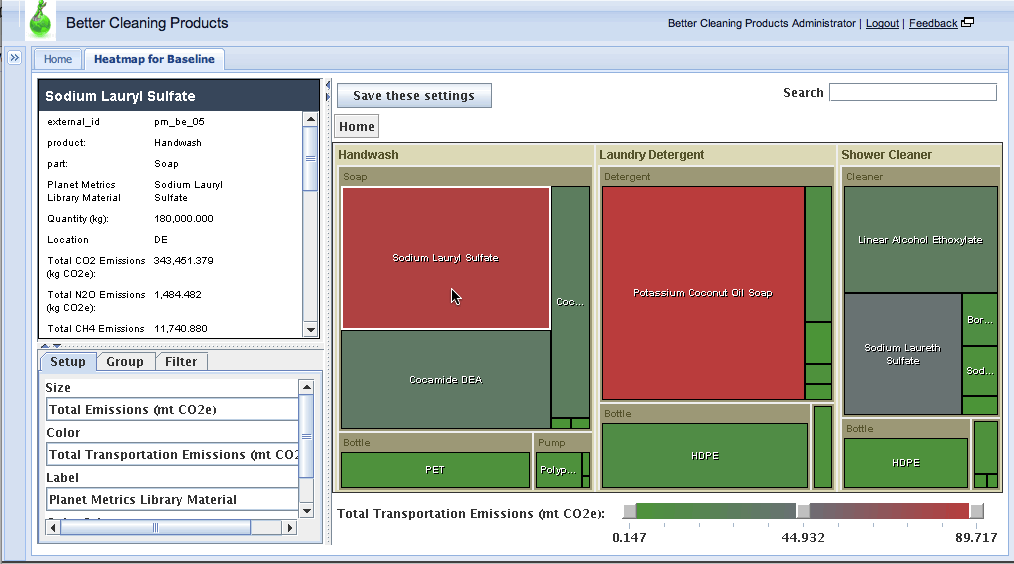
(Heatmap screen of new RCM software)

new Rapid Carbon Modeling (RCM) technology SaaS Solution sounds like a valuable resource for a wide spectrum of companies and industries. We took some time to connect with Andy Leventhal, founder and CEO of Planet Metrics, to learn a bit more about this exciting news.

COD: seems like it is being introduced to the market at a perfect time. Can you give us an idea of who you expect to use this tool and what the value proposition is for your customers?

Continue

{ 2 comments }

Posted on June 16, 2009 · in Interviews

Q. Hi Justin, and welcome to Carbon Offsets Daily. The recent news about cutting emissions by 30% is significant for business decision makers who are exploring ways to address their carbon footprints. Can you explain how you do it?

A. Well, we have been able to achieve this benchmark by reorganizing the common business model used in the shipping industry. Big shipping companies use a model known as “hub-and-spoke,” where they filter packages through a series of hubs before finally arriving at their destinations. For example, a package going from New York to Paris will go out of its way to Memphis and then to Brussels before finally arriving in Paris. This model is extremely wasteful and inefficient. Instead, what we do is partner with commercial airline companies. We place packages in their cargo holds that often have a great deal of extra room, which therefore allows us to get a package to its destination in one direct flight. Carbon emissions released by air transport are more damaging, since they are already so close to the atmosphere. So, being able to reduce these emissions by at least 30% when shipping direct is a significant improvement. Shipping in one direct flight also lets us deliver packages at least 24 hours sooner and for at least 20% less cost than other shippers.

Continue

{ 2 comments }

Posted on November 24, 2008 · in Interviews

Q. Hello Paul and welcome to Carbon Offsets Daily. Let’s first talk briefly about your business . What type of projects do you take and how do you help businesses go green?

Paul Smith GreenSmith Logo

Thanks Affan. I’m a bit of a green business Swiss army knife, offering a range of services, from social media marketing campaigns to creating a sustainability plan for inside/outside the company. Currently I’ve been doing a lot of social media marketing campaigns, with companies like , , and .

Q. How can sustainability consultants, offset providers and others offering green business solutions use the internet to promote their business?

That’s a big question, whose answer depends a lot on the type of company and who their target market is. I can help discern which.

For many, however, a common denominator is blogs and social media tools such as Twitter. They are free or very inexpensive means to get out the word about what you do, quickly, and ongoing. Being able to connect with, learn from, inform and be inspired by your customers goes a very long way towards building a strong foundation and solid sales for a business. For instance, I recently wrote an article about Berkeley, California based that got more than 150 people visiting their site directly from the article. That type of awareness of the exact effectiveness of marketing is powerful.

Another tool I recently saw is . It’s a simple, intuitive way for your customers to let you know what they’d like to see offered, and for you to let them know if it’s already in progress. People suggest ideas, see if they’ve already been submitted, and then have 8 total votes for whatever among the ideas interests them.

Q. In this regard, what would be the best choice for someone with a limited budget and time?

Hire me! But seriously, using tools such as Uservoice, the amazingly powerful , blogging, and social media news sites like , , and , if leveraged correctly, can produce great results. I will gladly consult with people to both do it for them and show them how to do it themselves. It’s not merely a matter of put content out there and hope for the best. But it also doesn’t have to be hard, either.

Q. For a business that wants to cut its footprint, what are the pros and (possible) cons of hiring sustainability consultants?

Let’s start with the cons. There are an increasing number of people calling themselves sustainability consultants. You should make sure their background and training is sufficient to have the knowledge you’ll want to know and the support you want for your business. At the same time, sustainability focused business as a broader trend is comparatively new, so be sure not to have standards beyond what any one person or company could have.

Using myself as an example, I am the product of one of the original sustainability focused MBA programs, , based in San Francisco. It gave both a broad, in depth knowledge of sustainable business, and at the same time, a solid grounding in how business has and is currently being done. In this way, I am able to act as a bridge between the two – I understand where are a business is coming from, and can help them get to where they want to go as a business, with confidence. Having someone that has a broad, current knowledge of sustainable business trends, issues, and opportunities, and isn’t merely an opportunist with superficial understanding of what’s going on could clearly be advantageous to a business.

Q. You can do many things to become carbon neutral, like improving on energy efficiency, using renewable energy, buying offsets, etc. In the log run, which method is more economical as an approach to cut footprint?

This again varies per business and would take some economic analysis. A model that has started in the consumer sector that I hope makes it into the commercial realm is that of solar as a service. is an example. They retain ownership of the solar panels, monitor and do all the maintenance at no charge, and you pay them a monthly utility bill, at a rate per kW that’s fixed, often at below current market rates, for 18 years. And if you happen to need to get out of the contract before then, it’s transferable to someone else, or you can outright buy the equipment, and be done.

{ 0 comments }

Posted on September 11, 2008 · in Interviews

The following interview is based on a story that we recently ran about JPMorgan “Cooking up Carbon Credits” (that you can view here: JPMorgan Chase Subsidizes Stoves in Africa to Earn Carbon Credits).
ClimateCHECK on the Future of Carbon Credits

The recent news about JPMorgan “Cooking up Carbon Credits” underscores the booming carbon market. It seems the carbon market is only going to get bigger. What do you think will happen as more capital gets into this market?

I do agree that the carbon markets will get bigger and that more capital will become available for carbon credits. The regulated markets will blossom once a legislated cap and trade system comes into force in the US and the voluntary markets will also grow as awareness of climate change increases. More capital will enable additional offset projects to be funded and will bring competition into the market which will increase the overall quality of offsets.

JPMorgan earns carbon credits by subsidizing stoves in Africa. These carbon credits are then sold to companies at a price that is reportedly higher than the retail value of the stove. Do you think such initiatives should be predominantly revenue driven?

I disagree with the concept of financial additionality because profitability is what motivates business decisions. If an emissions reduction project is limited to breaking even it is much less likely to be funded than another investment opportunity. I believe that, with plenty of competition, the free market will determine both a fair price for various projects as well as what level of quality is acceptable.

Do you think government intervention to subsidize carbon credits/cap credit prices will encourage more companies/individuals to offset their emissions?

I don’t believe that government subsidies would be the most effective means for stimulating the market. The government needs to set performance standards and emissions caps that are challenging to meet and let the free market determine the most efficient way of achieving them.

Pablo Päster
VP, Greenhouse Gas Management Innovations

{ 0 comments }

Posted on September 2, 2008 · in Interviews

The following interview is based on a story that we recently ran about JPMorgan “Cooking up Carbon Credits” (that you can view here: JPMorgan Chase Subsidizes Stoves in Africa to Earn Carbon Credits).

GreenLife on the Future of Carbon Credits

The recent news about JPMorgan “Cooking up Carbon Credits” underscores the booming carbon market. It seems the carbon market is only going to get bigger. What do you think will happen as more capital gets into this market?

Climate change is an enormous problem, and will thus require enormous resources to solve. It is not going to be solved by NGOs and people making donations alone. It requires these kinds of large-scale investments. My hope is that the capital flowing into carbon credits will spur investments in a wide variety of climate efforts: new technologies, acceleration in the growth in renewables, innovative strategies, etc. We are already seeing an increasing level of sophistication as more businesses and financial institutions get involved. Before long, carbon markets should function much more like mature existing commodity markets. What I am hoping we see more of, too, is billions in venture capital helping to finance projects at very early stages.

JPMorgan earns carbon credits by subsidizing stoves in Africa. These carbon credits are then sold to companies at a price that is reportedly higher than the retail value of the stove. Do you think such initiatives should be predominantly revenue driven?

I believe that money will flow to where profits can be made. If JP Morgan makes a lot of money on this project then hopefully millions or billions of other dollars will start flowing into more projects. That’s good.

Do you think government intervention to subsidize carbon credits/cap credit prices will encourage more companies/individuals to offset their emissions?

I do not think government should subsidize carbon credits or cap prices directly, although I do believe government can help to spur technologies and practices through effectively targeted tax policies (including elimination of counterproductive tax breaks). In fact, I believe that emission allowances should be auctioned and not given away (which is essentially a government subsidy). Voluntary carbon credits are pretty inexpensive now. I’m not sure government intervention to reduce prices will have much effect on the number of individuals or companies that choose to offset.

Steve Offutt
Business Development Director

{ 0 comments }

Posted on August 22, 2008 · in Interviews

Fossil fuels are the primary cause of climate change, which threatens catastrophic damages including massive sea-level rise, rising incidences of flood, drought and other extreme events, major water and food supply reductions, and the spread of disease.

INTERVIEW: Kevin Smith of PLATFORM - Unraveling the Carbon Web

PLATFORM’s focus is to reduce the environmental and social impacts of oil and to support the transition to a more sustainable energy economy. We recently posted on a new report, Cashing in on Coal, that Unraveling the Carbon Web released and caught up with Kevin Smith of to learn more.

What does Cashing in on Coal highlight?

The report highlights the role that private finance plays in pushing Continue

{ 0 comments }

Posted on August 13, 2008 · in Interviews

We recently caught up with Dan Lewer, the Co-Founder of the recently launched Carbon Retirement.

So what is your company all about?

Carbon Retirement was founded in 2008 by me and two colleagues. We wanted to offer a service focused on emission reductions. While we could see that there have been lots of interesting innovations in the voluntary market, we felt that it’s often difficult to evaluate the environmental benefits of offsetting projects. Retirement of allowances from EU Emission Trading Scheme – which is what we do – is a process that delivers unambiguous reductions in carbon emissions and we wanted to give everyone the opportunity to do it. We started taking orders in July this year.


How is Carbon Retirement different to other types of offsetting?

Existing types of offsetting work by investing in projects in the developing world that reduce emissions or absorb greenhouse gas from the atmosphere. Typical projects include tree planting and building renewable energy generators. Carbon Retirement is a fundamentally different approach – it works by buying heavy industry’s rights to release carbon dioxide.

What is the EU Emission Trading Scheme?

It’s a system that European governments use to support their commitments to reduce greenhouse gas emissions. It limits carbon dioxide emissions from a range of industries, including power generation, offshore extraction, cement production, iron and steel, paper and pulp and chemical processing. The EU Emission Trading Scheme is the world’s largest cap-and-trade scheme. In a cap-and-trade scheme, an authority allocates a fixed number of pollution permits to the participants. Each permit is a right to release pollution (in the EU Trading Scheme, each is the right to release one tonne of CO2). Permits can be traded between the participants. This creates a market in permits and a market price.

How is the price calculated?

One of our key principles is to be transparent about where our customers’ money goes. The price we charge is based on the market price of EUAs. For customers using our website, we add an admin fee of 10% (which pays the company’s overheads) and a ’spread fee’ of 5%. The spread fee covers the risk of the price moving upward between the order being made and Carbon Retirement purchasing EUAs. If the price goes down, we reserve the surplus for retirement of further EUAs. This breakdown is published on our website. For organisations that are thinking about retiring more than a couple of tonnes, the price would work differently.

Why does the price of EUAs change?

Fundamentally, the market price of EUAs is determined by the perceived cost of complying with the reduction required by the EU Trading Scheme. During trading, the market participants’ views of the cost of achieving the reduction can change, which is why the EUA price changes. Energy markets are important drivers. When demand for energy is high, demand for EUAs to cover the generation rises too. Burning coal produces particularly large quantities of greenhouse gases, so the price of EUAs is sensitive to demand for coal.

Where do you buy EUAs from?

From an exchange, a market broker or a regulated participant in the market. EUAs are freely tradable between market participants, so the source of an EUA does not affect the environmental benefits of retiring it.

Project-based offsets often have social benefits. Are there any social benefits to taking EUAs out of circulation?

We don’t think we’re fence-sitting here by saying sort of. We facilitate emission reductions in Europe, and we’re dealing with major energy-intensive industries, so there’s less opportunity for helping out communities at the same time.

The social benefits of offsetting projects can be hard to measure and we need to remember that our aim here is to reduce emissions. Globally, emission reduction and mitigation of climate change will have plenty of social benefits. We’re focused on making sure the emission reductions happen.

How does your calculator work?

Our website gives individuals the option of calculating the emissions associated with flights, driving or other activities, and then retiring a corresponding number of allowances.

Once data has been entered into the calculator, we multiply it by emissions factors. For example, if you input that you have driven a certain number of miles in a large petrol car, we multiply that distance by a factor showing the greenhouse gases released for each mile.

The factors and methodology behind the calculator follow the UK government’s guidelines for calculating a carbon footprint.

Where can I go to find out more about climate change and the EU Emission Trading Scheme?

For the trading scheme, I’d recommend the European Commission’s website. There’s also a straightforward overview on ’s site. There is a wealth of information about climate change out there. The BBC’s website is a pretty good place to start.

{ 1 comment }

Posted on August 5, 2008 · in Interviews

Carbon Offsets Daily: Do you think companies should use carbon offsets to mitigate their global warming emissions?

I don’t see anything wrong with a company purchasing carbon offsets in an attempt to mitigate their carbon emissions, but I don’t think that it’s a panacea to climate change situation. If purchasing carbon offsets (and advertising that fact) can increase a given company’s profits, then it should definitely do so. However, I think a more effective way to deal with a company’s carbon emissions is by reducing energy consumption and making its operations more efficient. Finally, I think the best way to mitigate global warming is not through the transfer of carbon credits in a cap-and-trade scheme, but rather by instituting a tax on sources of carbon emissions (such as coal, natural gas, petroleum products, etc.) so that non-carbon-emitting energy sources (such as wind, solar, nuclear, geothermal, etc.) become more cost-competitive.

Christopher Monnier

{ 3 comments }

Posted on July 30, 2008 · in Interviews